
 Home
Home
 Weddings
 Ideas
Ideas
 Advice
 Suppliers
The Whole Works
The Whole Works

By David
The web contains hundreds, if not thousands, of services for photographers—both professionals and amateurs. However, not all can be easily found via Google. Having a website is a great way to showcase your work to potential clients. You can share weddings you have captured, tell them about yourself, and outline the packages you offer.
An optimised website helps you and your services be easily found. If you are a wedding photographer based in Manchester, you want brides searching for a wedding photographer in Manchester to find you.

If you want to optimise your wedding photography website and make it a success, follow these 10 steps.
This should be your starting point: choose the right platform to showcase your best photography work and ensure it is optimised. This includes using search engine-friendly code—no Flash websites! Your site should be mobile-friendly, working well on all devices, including tablets and phones, as this impacts search rankings. Speed is also crucial; ensure your site loads quickly.
WordPress is a great choice—it’s free, with thousands of free and premium themes available, and is easily customisable.
Whatever platform you choose, make sure your pages load quickly, your website looks and works well on both mobile and desktop, and it showcases your work the way you want.
Plugins are essential as they allow you to edit important elements such as page titles and descriptions. While you can leave defaults in place and let Bing or Google decide what your page descriptions should be, as a wedding photographer website owner, you’d likely prefer to be in control.
Edit your page and blog post titles and descriptions to ensure they grab users’ attention when they are looking at search results on Google. Make your descriptions engaging and catchy to encourage clicks. Ensure your titles stand out as well. When crafting titles, search Google to see what others are using for inspiration and see what catches your eye.
Keywords are your focus topics and terms. They are the phrases you want a particular page to rank for in search results. Choose keywords that are likely to be searched by users. When writing a blog post, consider what terms users might use to find your content.
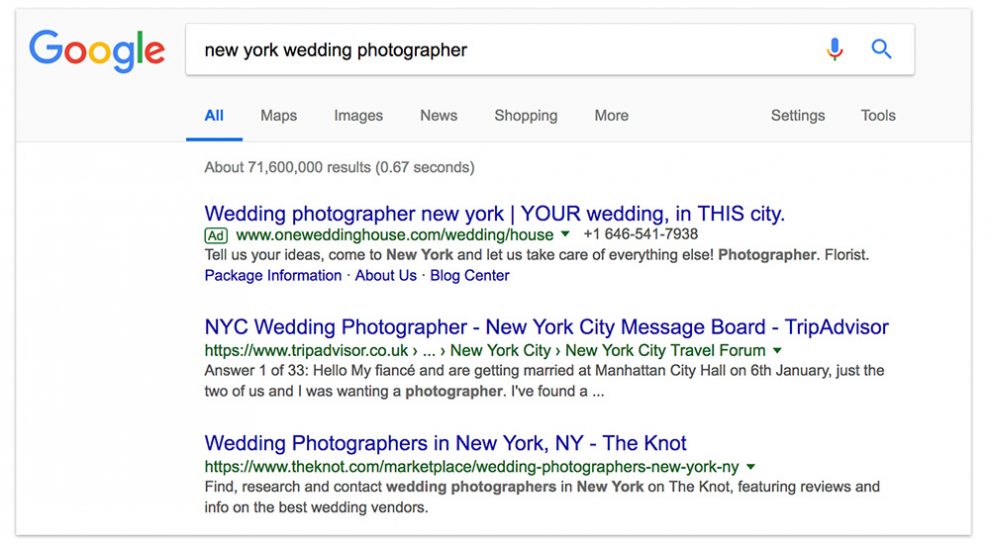
If you are a wedding photographer in New York, make sure to focus on this in your homepage title, description, and introduction. When someone searches for “New York wedding photographer,” you want to be easily found.
A page title typically consists of around 60 characters and should deliver a concise, compelling pitch. In the title, mention the main theme of the page and, where possible, include your brand. Ensure it captures the searcher’s attention and addresses what they might be looking for.
A page (or meta) description is the text that appears below the blue link in search results. This is your opportunity to provide a brief pitch—slightly longer than a tweet, but without shortening words. Elaborate on your page title by describing the contents and main subject of the page. Ensure it relates to the page’s content and explains why users should click through and read more.
While a single photo may be worth a thousand words, don’t just upload a photo to your website and leave it without context. Always caption your photographs. Since you are the creator, you are best suited to describe them. Add a paragraph or two explaining the photo, including details about the venue and location. This not only enriches the content but also makes it easier for search engines to find your work.
Including information about the venue and the context of the shot allows you to be found for other search terms, such as “weddings at XYZ venue.” If a couple is getting married at that venue and sees your work, they might be inclined to ask you to capture their special day.
Web addresses should be simple, straightforward, and easy to follow. Avoid dates or unnecessary complexity in your URLs, as these can make them harder to remember and less effective for search engines. Treat URLs like page titles; if you can’t remember them, search engines won’t either.
As a wedding photographer wanting to be found, optimising your photos is crucial. Avoid uploading large files; instead, compress them in Photoshop to a few hundred KB or less. Use plugins like WP Smush to further enhance photo loading speed. Also, include descriptive file names and alt tags to improve visibility in Google Image search. With thousands of photos, make the most of them to promote yourself effectively.
Website loading times are important for both users and search engines. Improve your WordPress load times for a better user experience, which can lead to higher conversion rates. W3 Total Cache is a great plugin for WordPress that will help improve your site loading time.
Link between pages on your site. If you write a blog post about a wedding you shot, link to the relevant page on your site, such as the gallery or about page. Help users navigate your site by including links to related content in your posts.
Take action on these steps—they are simple and quick to implement. Next time you write a blog post, keep these considerations in mind to improve your site’s SEO.
If your website is running off WordPress then ensure you have these plugins in use, you can download for free and are easy to set up.
Wedissimo Wedding Photography Awards From inception Wedissimo has hosted annual wedding photography awards. Previous awards, with guest judges, are set out below. The 2025 wedissimo wedding photography awards The Judge this year is Millie Pilkington, who is best known for her pictures of HRH Prince & Princess of Wales and remains one of the most […]
Read More
Proposed Changes to UK Marriage Laws: What You Need to Know The government has announced what it calls the biggest overhaul of marriage laws in England and Wales since the 19th century. The proposals aim to make weddings more flexible, boost the hospitality industry, and give couples more choice over where and how they marry. […]
Read MoreYou May Also Like
Explore more posts from the blog
Want In On Our Happy Wedding Letter?
Join over a thousand engaged couples (and counting) who have snagged our fun no-nonsense regular wedding advice and inspo straight to their inbox. Plus you'll get planning checklists & spreadsheets for absolutely nada.
© 2010 - 2026. Whimsical Wonderland Weddings Ltd & Wedissimo Ltd. All Rights Reserved.
Leave a Reply